Supporting Your Child's Journey into Writing

Many parents wonder when and how their child will learn to write. Is it when they first write their name? Or when they learn the alphabet? Early childhood research shows that writing actually starts much earlier, and it looks a lot like play!
Building a Writer's Foundation
Active play like running, jumping, and climbing does more than just burn off energy; it actually prepares your child's body for school! These big movements build the core strength, upright posture, and body awareness your child needs to succeed in the classroom. Without this physical foundation, children will struggle to sit comfortably in a school chair or hold a pencil in a proper grip when they start learning to write. Before kids can control a pencil, they need to build muscle from the top down, starting at the shoulder and moving down to the fingertips. Big movements like climbing and crawling build the steady shoulders and arm endurance needed so fingers can eventually hold and steer a pencil without getting tired. So, let's get moving!

A recent childhood literacy study highlights how you can support your child at home:
-
Celebrate Doodles and Scribbles: Scribbling builds hand strength and symbolic thinking. Instead of asking "What is it?", ask, "Tell me about your writing!"
- Expect a Rollercoaster, Not a Straight Line: Learning letters is hard work. It is completely normal for children to use letters one week and go back to pure drawing the next.
- Skip Worksheets, Keep it Real: Children learn best when writing has a purpose. Invite them to scribble items onto a grocery list, "sign" a birthday card, or draw a sign for their bedroom door.
- Trust the Timeline: Every child develops at their own pace. While girls sometimes start with an early advantage in letter forms, boys completely catch up over time when given a fun, relaxed space to explore.
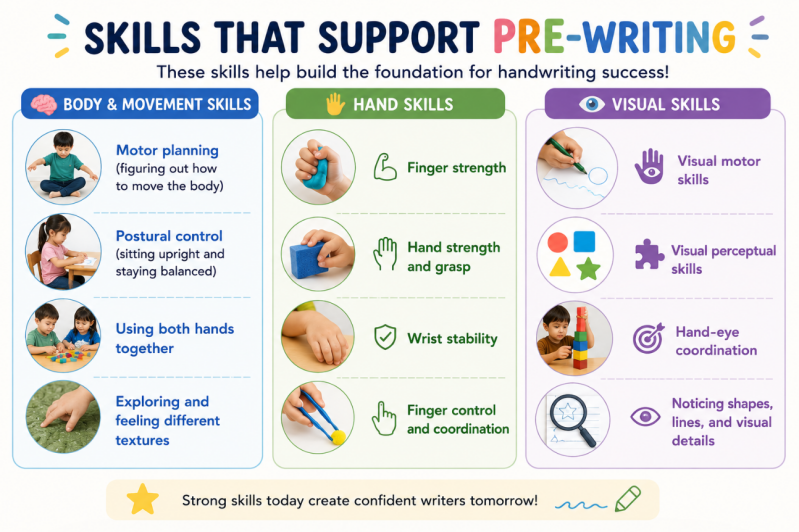
Daily Activities to Help With Prewriting Skills
Morning Dressing
Zipper & Button Power
- When getting your child dressed, step back and let them do the tugging! Encourage them to pull up their own socks, push buttons through slots, snap snaps, and yank up their zippers.
- Pulling and pushing against tight clothing works the big muscles in the shoulders, while pinching buttons builds the exact finger precision needed to hold a pencil later.


Playtime: Floor & Wall Fun
- Move playtime off the table and onto the floor or walls. Have your child lie on their stomach on the rug to build puzzles and play with cars, color, draw, or tape a large piece of paper to the fridge so they can color while standing up.
- Lying on the stomach builds upper back and arm endurance so they don’t slouch at a desk. Drawing on a wall forces the shoulder to anchor the arm against gravity, which is a major workout for writing control
Meal/Snack Time
- Messy Play: Spread pudding, ketchup, or yogurt thin onto a cookie sheet or highchair tray, and show your child how to make dots, lines, and shapes with a finger. This completely removes the friction and pressure of holding a pen, allowing them to focus entirely on learning the visual paths of shapes and curves.
- Give your child an almost-empty, flexible plastic squeeze bottle of ketchup, mustard, or honey, and let them squeeze lines or dots directly onto their plate or a piece of toast. Squeezing a resistant bottle provides excellent "heavy work" for the whole hand.
- Scatter small foods like raisins, blueberries, or puffs on a highchair tray or plate, and have your child pick them up one by one using only the tips of their thumb and pointer finger. This isolates the primary fingers used for writing, practicing the precise, gentle finger coordination needed for a mature pencil grasp.


Bathtime
-
Put liquid soap, shaving cream, or foam soap on the side of the tub at shoulder height and let your child use their index finger to copy your drawings.
-
DIY Soap Paint: Mix a small amount of liquid body wash with a drop of food coloring in a plastic cup. Let them use their fingers or a paintbrush to scribble on the walls.
-
Cup-to-Cup Pouring: Provide two small plastic medicine cups or small measuring scoops. When your child slowly pours water from one tiny cup into the other, it refines the small wrist rotations needed for smooth writing control.
-
Bath Crayons: If you would like to buy bath crayons, it is a wonderful addition to this routine.
Chores: Heavy Household Work
- Give your little helper "heavy" jobs around the house. Have them push the kitchen chairs into place, carry the laundry basket, wipe down low windows with a big wet sponge, or squeeze a spray bottle to help water the plants.
- Pushing, wiping, and lifting activate the shoulder joints and build core upper body stability, the essential "anchor" for a steady hand.


Meal Prep: Kitchen Counter Tasks
- Bring your child into the kitchen to help prepare meals. Let them turn the doorknobs to the pantry, twist the lids off plastic jars, or use their fingers to pinch and tear up lettuce or herbs for a salad.
- Twisting lids develops the wrist flexibility needed to rotate a pencil smoothly, while tearing food builds the finger strength required for a strong grip.
Grocery/Shopping
- Before you head out for shopping, hand your child a paper, and a marker, and have them "write" the shopping list alongside you by scribbling/drawing shapes. Once at the store, let them carry the list, check items off, and help push the grocery cart or lift sturdy items into the basket.
- Scribbling while standing up/sitting on a chair, the floor forces builds critical upper body stability. Combining this with pushing a heavy cart or lifting grocery items provides excellent "heavy work" that strengthens the shoulder and arm muscles, making it easier for fingers to eventually control a pencil.

Arts and Crafts at Home

Shaving Cream Tracing
Spread a thin layer of shaving cream (or whipped cream) on a baking sheet and let them draw shapes with their fingers.

Window Drawing and Cleaning
Let your child doodle on a glass window or sliding door with dry-erase markers or washable colors. Then, hand them a spray bottle filled with water to mist their drawings and wipe the glass clean with a cloth while standing up.

Zip-Lock Gel Writing
Fill a sealable plastic bag with cheap hair gel and a few drops of food coloring, tape it flat to the floor or a chair, and let them trace shapes through the gel with a finger.

Salt Tray
Pour a thin layer of salt or sugar into a shallow cake pan and let your child use a finger to reveal a colorful piece of paper taped underneath.

Wall Bubble Wrap Pop
Tape a sheet of bubble wrap to a wall or door at your child's shoulder height and have them pop the bubbles using their thumbs and pointer fingers while standing.

Playdough and Clay
Encourage your child to roll, pinch, and squeeze the dough, which builds the specific finger muscles needed for a "pincer grasp"

Tweezers and Tongs
Have them use child-safe tweezers to sort small items like pom-poms, beads, or cereal into a muffin tin.

Stickers peeling and placing
Peeling and placing stickers requires careful, purposeful finger movement and pressure
Drawing thick lines on paper and having your child peel stickers to place along the path perfectly combines fine motor strength with visual tracking. This playful activity strengthens the thumb and index finger muscles while training the eyes to guide the hand accurately along a baseline.

Vertical Surface Drawing
Tape a large piece of paper or chalkboard to the wall. Having children color, paint, or draw vertically forces them to use their shoulder and wrist muscles instead of just their fingers.

Animal Walks
Have them crawl like a bear, jump like a frog, or do "wheelbarrow walks" across the room to strengthen their arms and core

Clothespins Activity
Squeezing wooden clothespins to match colored dots around a paper plate. This activity builds pre-writing skills because squeezing a clothespin isolates and strengthens the exact same three fingers used to hold a pencil

Threading beads onto pipe cleaners
Threading beads onto pipe cleaners: Bending the flexible wire requires precise finger manipulation and two-handed control. Sliding beads down the textured surface reinforces visual tracking and develops finger dexterity.
Resources/Reference
Papadopoulos, I. (2026). Emergent Writing in Early Childhood: Developmental Patterns in Drawing, Scribbling, and Letter-Like Forms. International Journal of Early Childhood. https://doi.org/10.1007/s13158-026-00506-z
Create Your Own Website With Webador